
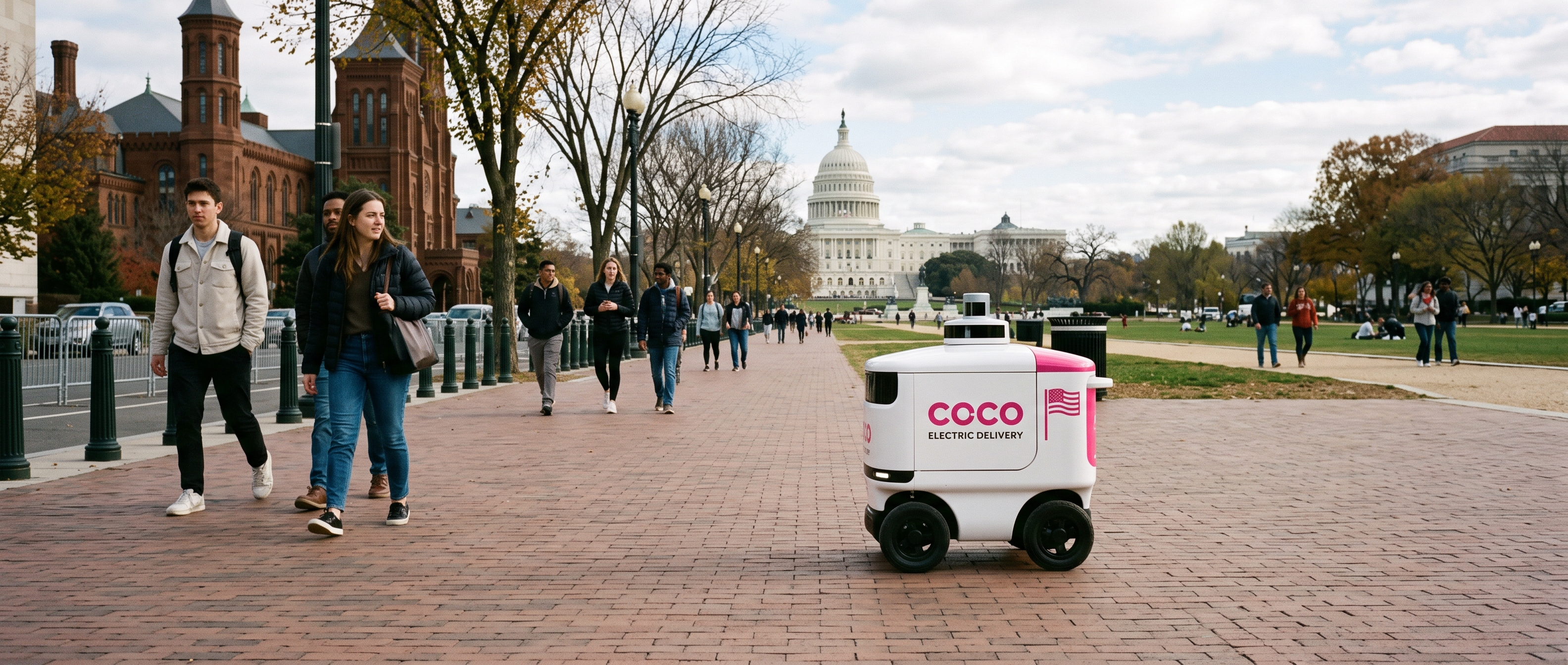
Sam Altman-Backed Delivery Robots Are Headed to D.C.
Washington, D.C. is about to get a firsthand look at the future of food delivery—and it may arrive on four wheels carrying your lunch.
According to the Washington Business Journal, Coco Robotics, an autonomous delivery company backed by OpenAI CEO Sam Altman, plans to launch its robot food-delivery service in Washington, D.C. later this summer.
The initial rollout is expected to begin in Logan Circle, where a fleet of approximately 25 robots will deliver food and small retail orders to customers. Coco Robotics is working with restaurants, retailers and major delivery platforms, including Uber Eats and DoorDash.
If the Logan Circle launch is successful, the company reportedly plans to expand into Dupont Circle and potentially other neighborhoods across the District.
What Are Coco Robotics Delivery Robots?
The robots look like small coolers on wheels. They stand approximately two feet tall, weigh about 100 pounds and can travel at speeds of up to five miles per hour.
They are designed to travel along sidewalks and navigate city streets, intersections and crosswalks while carrying orders directly to customers.
Ahead of its Washington launch, Coco Robotics worked with the District Department of Transportation to make sure the robots could safely operate in the city’s busy pedestrian environment.
The company says its robots can potentially reduce delivery expenses by as much as 20%. That could help make food delivery more affordable for customers while allowing restaurants to serve more people without relying on additional vehicle trips.
Coco Robotics was founded in 2020 and has already completed more than 500,000 deliveries. The company currently operates in Los Angeles, Miami, Chicago, Jersey City, San Jose and Helsinki, Finland.
Its expansion into Washington represents another major step in the growth of autonomous delivery technology across the D.C. region.
Why I Think This Could Be Huge for D.C.
I think this could be huge for Washington, D.C.
This story is about much more than having a robot deliver someone a hamburger.
Washington is one of the country’s most walkable, densely populated and restaurant-driven cities. Neighborhoods like Logan Circle, Dupont Circle, Georgetown, Shaw, Capitol Hill and Navy Yard have thousands of residents, workers and visitors ordering food every day.
That makes D.C. an ideal environment for autonomous delivery.
If the technology works as intended, it could help reduce the number of short vehicle trips being made throughout the city. It could also ease pressure on busy streets, reduce delivery costs and give local restaurants a more efficient way to reach nearby customers.
Think about how many drivers currently circle neighborhoods looking for parking, double-park outside restaurants or travel several blocks to complete a relatively small delivery. A sidewalk robot could potentially complete some of those trips without adding another car to the road.
That could be especially valuable in dense neighborhoods where parking is limited and traffic congestion is already a daily concern.
What This Could Mean for Local Restaurants
For local restaurants, delivery has become an important part of doing business—but it can also be expensive.
Restaurants often have to balance delivery-platform fees, staffing expenses and the cost of getting orders to customers quickly. If autonomous delivery lowers some of those costs, it could allow restaurants to complete more orders while improving their margins.
It could also make delivery more practical for smaller neighborhood businesses that may not have their own delivery staff.
Coco Robotics says its goal is not simply to make delivery more efficient. The company believes the technology can help local businesses grow, make delivery more affordable and reduce unnecessary vehicle trips.
If the company can deliver on those promises, D.C. restaurants could be among the biggest beneficiaries.
Could Delivery Robots Change the D.C. Experience?
The robots could also become part of the experience of living in and visiting Washington.
Imagine walking through Logan Circle and seeing autonomous robots delivering meals along the sidewalk. For tourists, families and residents, the technology will likely attract attention—especially during the first few months.
What initially feels unusual could quickly become part of everyday city life.
We have seen this happen with other technologies. Services that once seemed futuristic, including ridesharing, mobile food delivery and self-checkout, eventually became normal parts of daily life.
Autonomous delivery robots could follow a similar path.
D.C. Is Becoming a Testing Ground for Autonomous Technology
Coco Robotics is not the only company bringing autonomous delivery technology to the region.
Other robot-delivery services have recently launched in Arlington and Alexandria, showing that the broader Washington metropolitan area is becoming an important testing ground for this industry.
The region offers technology companies a unique mix of dense urban neighborhoods, walkable communities, major employment centers, universities, tourists and suburban population growth.
That combination could make the DMV one of the country’s most important markets for autonomous delivery.
If Coco’s Logan Circle rollout is successful, I would not be surprised to see the service expand quickly into other parts of D.C.—and eventually into additional communities throughout Northern Virginia and Maryland.
What Challenges Could the Robots Face?
There will still be plenty of questions to answer.
Washington sidewalks can be crowded, uneven and unpredictable. The robots will have to navigate pedestrians, pets, bicycles, scooters, construction zones, bad weather and busy intersections.
Accessibility will also be important. The robots cannot interfere with wheelchairs, strollers or pedestrians who need additional space to safely use the sidewalk.
Security could be another concern. People may wonder whether the robots can be damaged, blocked or tampered with while carrying orders.
Those challenges will help determine how quickly the service expands.
The initial fleet of approximately 25 robots should give Coco Robotics and city officials an opportunity to study how the technology performs before placing significantly more robots on D.C. sidewalks.
The Future Is Arriving One Neighborhood at a Time
Major technological changes do not always arrive through one dramatic moment.
Sometimes they begin with 25 small robots quietly delivering food around one neighborhood.
If residents use the service, restaurants see value and the robots operate safely, the Logan Circle launch could become the beginning of a much larger transformation.
Autonomous delivery may eventually become a normal part of how food, groceries and retail products move throughout dense communities.
That could have an impact on transportation, local businesses, consumer behavior and even the types of amenities people expect when choosing where to live.
The biggest question may no longer be whether autonomous robots will become part of daily life in Washington.
It may be how quickly they spread throughout the city—and the rest of the DMV.
Would you trust a robot to deliver your next meal?
"According to the Washington Business Journal, Coco Robotics plans to begin offering delivery service in Washington later this summer. The first rollout is expected to take place in Logan Circle." "The service will initially operate in Logan Circle with a fleet of approximately 25 robots. If the launch performs well, Coco reportedly plans to expand into Dupont Circle and potentially other neighborhoods." "Coco Robotics has not publicly announced a Northern Virginia expansion. However, other autonomous delivery services are already operating in Arlington and Alexandria. If the D.C. rollout succeeds, future expansion into additional DMV communities is certainly possible."Frequently Asked Questions
When will Coco Robotics launch in Washington, D.C.?
Where will the Coco Robotics delivery robots operate?
Could Coco Robotics expand into Northern Virginia?
This article is based on reporting by Alan Kline of the Washington Business Journal. Additional commentary and analysis represent the author’s opinion.
About Chris Colgan

Chris Colgan is the founder of Real Nova Network and team leader of Chris Colgan – Real Brokerage LLC – Powered by PLACE.
Through colganteam.com and realnovanetwork.com, Chris covers Northern Virginia real estate trends, major developments, and hyper-local market updates to help buyers and sellers make confident decisions.
Thinking about moving to Northern Virginia? Get my free Northern Virginia Relocation Guide — packed with neighborhood breakdowns, schools, commute tips, and real insider insight.
Subscribe to my YouTube channel, Northern Virginia Living with Chris Colgan, for neighborhood tours, real estate insights, and updates on major developments across the region.
Posted by Chris Colgan on
Enjoy this blog post? Click here to subscribe for updates
Leave A Comment