
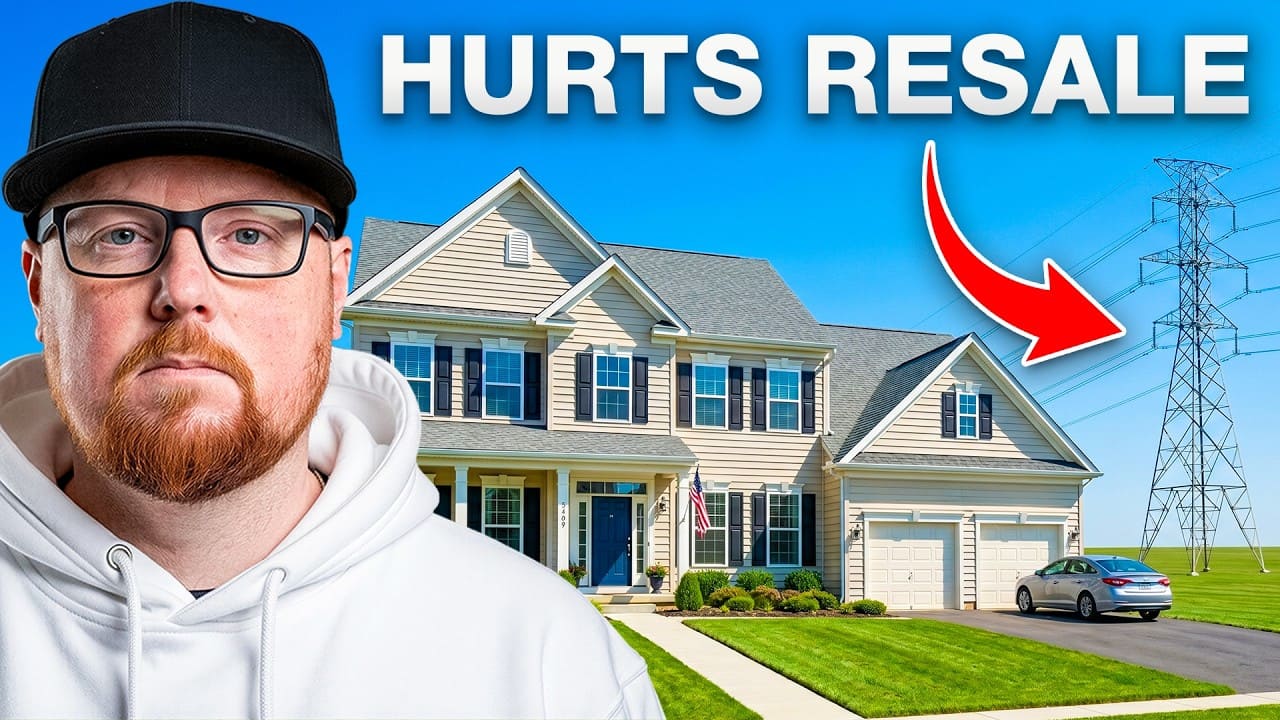
Northern Virginia Resale Red Flags
Thinking about buying or selling in Northern Virginia? I'm Chris Colgan, a top-producing Realtor with the Chris Colgan Team at eXp Realty, and your guide to the Northern Virginia & DMV real estate market.
The homes that wreck your resale in Northern Virginia aren't just the ugly ones. Some perfectly nice-looking houses have problems hiding behind a shiny listing photo. After 22 years in this business, I'm breaking down 10 features that shrink your future buyer pool and cost you tens of thousands of dollars when you go to sell. (0:00)
Why This Hits Different in 2026
Think back to the frenzy years. Buyers would tour a house with three obvious problems and still write an offer that night. Those buyers don't really exist anymore. Northern Virginia has shifted from a seller frenzy where anything sold to a balanced market where buyers can afford to be picky again, and I'm seeing it all across the DMV. When buyers have options, anything with a visible negative becomes the easiest home to skip. So the smart move when you buy is to ask: who's going to want this from me in five or ten years, not just whether I like it today? One thing I tell sellers all the time: what really sold you on this house when you bought it, and is that thing still in the same condition? If the primary bathroom was amazing then but it's 15 years older now, it may need an update. (0:20)
For context, Northern Virginia's median home price sits around $760,000, with Fairfax County around $750,000. Active inventory is up depending on the subregion, which gives buyers more leverage, and homes are averaging about 25 to 30 days on market, still fast compared to most of the country, but a different game than those 48-hour bidding wars from the COVID years. (1:20)
Key Takeaways
- The market is balanced now, so visible negatives cost you far more than they used to. (0:35)
- Backing to a data center or power lines creates immediate buyer hesitation. (2:03)
- In most NoVA price points, a garage is a baseline expectation, not a luxury. (3:56)
- A pool narrows your buyer pool here and rarely returns its cost. (6:00)
- A steep or unusable lot loses to a flat, usable one every time. (7:57)
- A closed-off kitchen reads as dated, and functional fixes are expensive. (9:58)
- Well and septic are fine, missing documentation is the real problem. (10:52)
- Unpermitted COVID-era work creates appraisal and financing nightmares. (12:38)
- Buying early-phase new construction can tank your resale if you move soon. (14:06)
- Roads in VDOT bond limbo and bad locations are the hardest things to fix. (15:39, 16:34)
1. Backing Up to a Data Center or Power Lines
Picture standing in your backyard at 9 p.m., a beer in hand, and there's a constant low droning hum you just can't escape. That's daily life for some homeowners around here. Backing up to a data center or having huge power lines running through your yard creates immediate buyer hesitation. It's the noise, the visual, and the general "what's coming next" uncertainty. Some of the data centers in Sterling and parts of Loudoun have residents complaining about a constant hum or whine you can hear from inside the house, and that's not a vibe most buyers sign up for. (2:03)
Power lines hit resale even more consistently. Buyers see those huge towers in the backyard and immediately picture future buyers and whether their kids should play under them. People exaggerate them too, "I heard they cause this, animals die," and it spirals. Northern Virginia is home to the world's largest concentration of data centers, with roughly 200 operational facilities just in Loudoun County. Some studies suggest homes close to high-voltage power lines, within about 1,000 feet, can sell for meaningfully less than comparable homes without that exposure. And keep this infrastructure in mind, because the bond-and-approval problem shows up again later with road turnover. (2:57)
2. No Garage or a Bad Parking Situation
I can't tell you how many times I've shown a house and the buyer literally won't get out of the car. They take one look at the parking and they're done. In Northern Virginia, buyers expect a garage at most price points, especially in the mid and higher ranges, and a home without one immediately feels like a compromise. Parking is a first-impression killer, people pull up, see the chaos on the street, and decide before they ever walk inside. (3:45)
This matters most in townhomes where street parking is tight or visitor parking is way down the block. Buyers picture hosting family for the holidays and get turned off fast. I had a listing in the Woodbridge area with one assigned spot and a quarter-mile walk to visitor parking, we had to disclose it, and it really hurt the resale. More buyers here are also driving EVs like Teslas, and no garage means no easy charging setup, which becomes a real conversation at resale. Homes without garages in neighborhoods where they're standard typically sell at a discount and sit longer, and that describes the bulk of Northern Virginia. At our median price points, a garage isn't a luxury upgrade, it's a baseline expectation. (4:03)
3. A Pool (Yes, Really)
This one surprises people, because everyone hears "pool" and thinks luxury. But in Northern Virginia, that pool might be the exact reason your buyer walks away. A pool can be great for the right buyer, but it does not widen your market here, it moves the home into the "no thanks" pile for a lot of buyers. They think liability with young kids, maintenance, insurance, and the fact that you only use it a few months a year. I'm showing a multimillion-dollar buyer in Fairfax right now who wants a pool, and it's been a struggle because so many sellers won't open the pool or keep up the maintenance and inspections. It adds another layer to selling a house. (5:52)
Our outdoor swim season is roughly June through early September, so the lifestyle case is much weaker than in Florida or Texas. Pool installation in 2026 runs about $30,000 to $60,000, and I've seen them go much higher here, someone I know paid around $120,000 because Northern Virginia is so rocky they sometimes have to dynamite to dig. Most owners recover only about 40 to 60% of the install cost at resale, so the math usually doesn't work in your favor. A well-maintained pool in great condition might add around $10,000 to $30,000 in perceived value, but a pool with deferred maintenance can cost you $5,000 to $15,000 in buyer credits or price reductions. If you have one, have a professional company service it and keep the records, so you can hand the buyer a clean maintenance history. (6:37)
4. A Steep or Heavily Sloped Lot
More land is not always a win. I've walked buyers down a backyard while they held my arm because the slope was so bad. That's not a selling point, and for families with small kids it can be dangerous. Buyers tell me they want 10 acres for horses, and I have to point out that the 10 acres runs down the side of a mountain, no horses are grazing on that. A steep or heavily slanted lot fails the basic test of usability. (7:57)
Buyers picture a flat backyard for kids, entertaining, and a play set, and a steep slope kills all of that in their head. They start thinking about drainage, water running toward the foundation, and mowing a hill. A flat half-acre beats an awkward acre every single time at resale. Studies analyzing hundreds of counties show homes with backyards sloping uphill toward the house tend to sell for less than homes with flat or downhill-sloping yards. Adding a fence, deck, patio, or play structure on a steep lot usually requires extra grading, retaining walls, or engineering that runs into the thousands, and drainage issues from steep lots are one of the top concerns flagged in Northern Virginia home inspections, especially in our clay-heavy soil. I see it kill deals all the time. (8:46)
5. A Closed-Off, Isolated Kitchen
This is probably the biggest functional issue I see hurting resale right now, and you feel it the second you walk in. Quick personal example: my wife and kids are in the kitchen and family room about 90% of the day. I've got a girl about to turn three and a son about to turn one, so they're in the family room while she's cooking in the kitchen with the dog. That's where life happens, and buyers feel that the moment they walk in. The "Leave It to Beaver" days of everyone sitting in the formal dining room are gone, now everyone chills in the family room next to the kitchen. (9:27)
So buyers in 2026 want kitchens that are open and connected to the family room. A tiny kitchen, or one walled off from the main living space, feels dated immediately. Functional obsolescence is much harder to overcome than cosmetic stuff, buyers can repaint cabinets and swap countertops, but knocking down walls means permits, structural questions, and a lot of money, so most just skip the house entirely. Open-concept layouts can boost home values by around 7%, and the 2026 trend is shifting toward "broken-plan" designs that still connect kitchen and living space but add some architectural definition. Either way, the isolated kitchen is dead. (10:28)
6. Well & Septic Without Documentation
This is common in the more rural parts of the area, like Western Loudoun, Prince William County, and Stafford, and the answer might surprise you: well and septic are not always a problem. I grew up on well and septic, and look at me, I'm perfect. These systems are common in Western Fauquier, parts of Western Prince William, and rural pockets of Fairfax like Clifton, so it's not a deal-breaker by itself. The real issue is documentation and condition. If the seller can't prove the system has been well-maintained, buyers and lenders start seeing risk instead of value. (10:52)
A failing septic system can absolutely tank a $700,000-plus sale, and a well with no recent water testing creates buyer anxiety and lender pushback every time. I see it constantly: they do a well-and-septic test, check the distribution box, the crew digging breaks it, and it's about $2,500 to fix plus permits. A conventional septic system in Virginia runs about $8,000 to $30,000, and an advanced or alternative system can run $13,000 to $40,000. Virginia's House Bill 2671 took effect July 1, 2025, and it sets a minimum standard for septic inspections when one is requested as part of a sale, the inspection has to cover all components and include pumping the tank, with a written report due within 10 business days. It doesn't force an inspection on every sale, but if one is ordered, it has to meet that standard. Septic tanks should be pumped every 3 to 5 years, and well water should be tested for bacteria, nitrates, and pH at least every 12 months. Almost every house fails a well-water test at first, so don't freak out, you can treat it or add a water-treatment system. (11:47)
7. Unpermitted Basements & Additions
Here's something showing up in transactions all over, and it traces back to one specific period. A home is marketed as a 5-bedroom, three-and-a-half bath with a beautiful finished basement, the whole nine yards, except the basement bedroom and bathroom were never approved by the county. That's a huge problem. During COVID, a ton of homeowners and investors finished basements, added bedrooms and bathrooms, and converted garages without pulling permits, partly because a lot of county offices were closed. (12:28)
Counties can make your life miserable. They want proper permits and tax records, and they want to verify the work isn't a fire hazard, with proper egress, smoke detectors, and electrical. It affects appraisals too: if your home appraises based on a basement bedroom that doesn't officially exist, you've got a financing and disclosure nightmare. Buyers should pull permits before going under contract on anything that looks recently renovated, it's free and online for most counties. Agents are even hearing that Fairfax County has been cross-checking listings against permit records, so they're being strict right now, and retroactive permits often require gutting walls to expose framing and mechanicals, plus double permit fees. Permit history is generally free online in Fairfax, Loudoun, and Prince William counties, and FHA and VA loans have strict property-condition requirements, so unpermitted conditions can disqualify a buyer from those programs. (13:01)
8. Buying Early-Phase in an Unfinished New-Construction Community
This one is specific to Northern Virginia in 2026 and trips up smart buyers all the time. When you sell, you're not just competing with other resale homeowners, you're competing with the builder next door who has incentives, a model home, and brand-new inventory. That's almost impossible to beat, keyword almost, as long as you avoid this trap. If you buy in phase one or two of a new community and need to resell before the builder is done, your almost-new home is essentially "used" compared to theirs. (13:47)
Builders are offering rate buydowns 1 to 2% below market, closing-cost credits in the $10,000 to $20,000 range, design-upgrade allowances, and fresh inventory you can't match at the same price point. So if you might relocate in a few years, that timeline can tank your resale, and I probably wouldn't do new construction. Picture putting your house up for sale while they're still building: the buyer asks, do I want a brand-new one where I choose everything, or this similar resale? It's the kiss of death. Make sure the community is either done or really close to done before you sign. New-construction inventory growth has been strongest in Fairfax, Loudoun, and Prince William through 2026, and when buyers can choose between new and resale at similar prices, they almost universally pick new, which leaves phase-one buyers competing on price alone. (14:21)
9. Roads Not Yet Accepted by VDOT
Speaking of new-construction communities, here's a behind-the-scenes problem nobody warns you about until you're living there. I've seen roads in some newer communities sit looking like trash for two years, more craters than the moon, no plowing, no road markings, just nothing. There's a specific reason. In newer Northern Virginia communities, the developer has to post a bond with the county and complete the paperwork before VDOT takes over the road. If the developer hasn't finished that process or runs into delays, your roads are in legal limbo, and nobody's officially responsible for maintaining them. (15:11)
If you're touring a newer community and the roads look rough, ask the listing agent or HOA when VDOT is taking over. If nobody can give you a clear answer, that's a red flag. The VDOT bond-release process in Loudoun and Fairfax requires a final inspection of the public improvements before the state accepts the road into the secondary maintenance system, and until it's accepted, snowplowing, pothole repair, and surface maintenance aren't on any official schedule. A common error is developers not initiating VDOT acceptance in a timely manner, which can leave roads unmaintained for years after homes are occupied. If you've ever driven through a new build where the roads are rough and the storm drains stick up, that's because VDOT hasn't taken it over yet. (15:54)
10. A Bad Location
This might be the most important on the entire list, because you can't fix it. You can renovate a kitchen and repaint a house, but if the property is in a bad location, there's no fixing that unless you can make development sprout from the ground overnight. In Northern Virginia, location is the most durable resale variable on this whole list. A home 20 minutes from the nearest town center or real conveniences becomes an island, every grocery run, coffee stop, and kids' activity turns into a project. Buyers here are commute-conscious and convenience-driven, they calculate that daily friction without even realizing it, and it crosses homes off the list fast. (16:34)
Walkability, or even short driving access to grocery stores, restaurants, and retail corridors, consistently drives values up, and distance from those things drives values down. Remember, buyers have way more choices in 2026, so they're far less willing to accept inconvenient locations than they were a few years ago. And be careful with "it's coming soon" promises, make sure that retail or amenity is actually breaking ground, because I've seen projects fall through and kill home values. Nearly 80% of buyers prioritize walkability and many will pay a premium for it, and the price gradient here is dramatic: inner-ring, walkable corridors push median prices higher while the outer reaches drop noticeably as convenience falls off. For a full county-by-county look at where those conveniences and price points line up, see my complete guide to Northern Virginia for 2026. (17:08)
The Bottom Line
The best resale homes have strong fundamentals and features that keep attracting buyers year after year. When you buy with your future exit in mind, it gets easier to tell a real opportunity from a short-term bargain. I've told plenty of buyers, "I know you love this house, but there's a highway right behind it, and that's going to hurt you at resale." You need an agent who's upfront with you like that. If you want me to walk a property with you before you make a mistake, email me at info@colganteam.com or grab my free relocation guide at northernvirginiarelocation.com. And if you want to understand why some well-priced homes sit while overpriced ones still draw offers, my breakdown of the biggest seller and buyer mistakes in Northern Virginia is the perfect follow-up. For more on the data-center growth driving some of these location calls, see Northern Virginia's future growth. (18:04)
Yes. Backing to a data center or large power lines creates immediate buyer hesitation, the noise, the visual, and uncertainty about what's coming next. Some Sterling and Loudoun residents report a constant hum or whine audible inside the house. Loudoun County alone has roughly 200 operational data centers, part of the world's largest concentration. Studies suggest homes within about 1,000 feet of high-voltage power lines can sell for meaningfully less than comparable homes without that exposure. (2:03) In most NoVA price points, yes. Buyers expect a garage, especially in the mid and higher ranges, and a home without one feels like a compromise. Bad parking is a first-impression killer, buyers will decide before they even get out of the car. It matters most in townhomes with tight street or visitor parking, and with more buyers driving EVs, no garage means no easy charging. Homes without garages in neighborhoods where they're standard typically sell at a discount and sit longer. (3:56) Usually not enough to justify it. Our outdoor swim season is only about June through early September, so a pool narrows your buyer pool more than it widens it, many buyers think liability, maintenance, and insurance. Installation runs about $30,000 to $60,000 (sometimes far more here because of rocky soil), and most owners recover only 40 to 60% at resale. A well-maintained pool might add $10,000 to $30,000 in perceived value, but one with deferred maintenance can cost you $5,000 to $15,000 in credits or reductions. (6:00) No. More land isn't a win if it's not usable. A steep or heavily sloped lot fails the basic usability test, buyers want a flat yard for kids, entertaining, and play sets, and they immediately think about drainage and water running toward the foundation. A flat half-acre beats an awkward sloped acre every time. Adding a fence, deck, patio, or play structure on a steep lot often needs extra grading or retaining walls that run into the thousands, and drainage is a top inspection concern in our clay-heavy soil. (7:57) Because buyers in 2026 want the kitchen open and connected to the family room, that's where daily life happens. A tiny or walled-off kitchen reads as dated immediately, and that kind of functional obsolescence is much harder to fix than cosmetics. Buyers can repaint cabinets or swap countertops, but knocking down walls means permits, structural questions, and real money, so most just skip the house. Open-concept layouts can boost values around 7%, with the 2026 trend favoring "broken-plan" designs that connect spaces while keeping some definition. (9:58) Not by themselves, they're common in Western Loudoun, Fauquier, parts of Prince William, and rural Fairfax. The real issue is documentation and condition. A failing septic system can tank a $700,000-plus sale, and a well with no recent water test creates lender pushback. Conventional septic systems run about $8,000 to $30,000 and advanced systems $13,000 to $40,000. Keep your tank pumped every 3 to 5 years and test well water yearly, and keep the records, so buyers see value instead of risk. (10:52) House Bill 2671 took effect July 1, 2025. It doesn't require a septic inspection on every sale, but when one is requested by a buyer, seller, lender, or agent, it must meet a minimum standard: a licensed inspector has to physically inspect all components, pump the septic tank, and submit a written report within 10 business days. The goal is consistent, fact-based inspections so buyers aren't surprised after closing. If you're selling a home on septic, pulling the operation permit and servicing the system early helps avoid problems. (11:47) It can become an appraisal, disclosure, and financing nightmare. A lot of COVID-era basements, bedrooms, and garage conversions were done without permits while county offices were closed. If a home appraises on a basement bedroom that doesn't officially exist, the deal can fall apart, and FHA and VA loans have strict property-condition rules that unpermitted work can violate. Buyers should pull permit history (free online in Fairfax, Loudoun, and Prince William) before going under contract. Retroactive permits often mean opening walls and paying double fees. (12:38) Be careful if you might move within a few years. If you buy in phase one or two and need to resell before the builder finishes, your almost-new home competes against the builder's incentives, rate buydowns 1 to 2% below market, $10,000 to $20,000 in closing-cost credits, design upgrades, and fresh inventory. When buyers can choose new or resale at similar prices, they almost always pick new, leaving early-phase owners competing on price alone. Make sure the community is done or nearly done before you sign. (14:06) In newer communities, the developer posts a bond and must complete a process before VDOT accepts the roads into the state maintenance system. Until that happens, the roads are in legal limbo, snowplowing, pothole repair, and surface maintenance aren't on any official schedule, and it can drag on for years if the developer delays. If you're touring a newer community with rough roads, ask the agent or HOA when VDOT is taking over. If no one can answer clearly, treat it as a red flag. (15:39) Because it's the one thing you can't fix. You can renovate a kitchen or repaint a house, but you can't move a property closer to conveniences. A home 20 minutes from the nearest town center becomes an island, every errand is a project, and NoVA buyers are commute-conscious and convenience-driven. Walkability and short drives to groceries, restaurants, and retail consistently push values up, while distance drives them down. Nearly 80% of buyers prioritize walkability, and the price gradient between walkable inner corridors and the outer reaches is dramatic. (16:34)Northern Virginia Resale FAQs
Does backing up to a data center or power lines hurt resale value in Northern Virginia?
Do I really need a garage to sell a home in Northern Virginia?
Does a pool add value to a home in Northern Virginia?
Is a bigger lot always better for resale?
Why does a closed-off kitchen hurt my home's value?
Are well and septic systems a problem when selling in Virginia?
What is Virginia's HB 2671 septic inspection law?
What happens if a basement or addition was finished without permits?
Should I buy in an early phase of a new-construction community?
What does it mean when a community's roads aren't accepted by VDOT yet?
Why is location the most important resale factor in Northern Virginia?
Enjoy this blog post? Click here to subscribe for updates
Leave A Comment